
Cloud Billing Has Its Own Chaos Theory. Here's How to Beat It.
Most FinOps tools only solve the output side of multi-tenant billing. This post explains why the real complexity starts at the source, and how to normalize it into one trusted financial model.
Imagine you're a property investor.
You start small. One condo, split 50/50 with a friend. Then another. Then a quadplex. Then a house with a different partner.
Before long, you're managing multiple properties, each with its own setup.
One condo is leased for 12 months. Another is nightly on Airbnb. The basement is rented out as a storage unit.
Some tenants pay utilities. Others have them included. Maintenance pops up when you least expect it.
Now you want to step back and review your portfolio.
Which properties are actually profitable? Are you charging the right rent? Is Airbnb worth the complexity? Should you sell one asset and reinvest elsewhere?
That's the real challenge.
Not collecting rent but understanding performance across a shared, constantly changing portfolio.
That's exactly the challenge FinOps faces today.
The Problem Isn't Just"Many Customers" It's Where the Data Comes From
Most people hear"multi-tenant billing" and assume the complexity is on the output side — lots of different customers to report to. That's only half the picture.
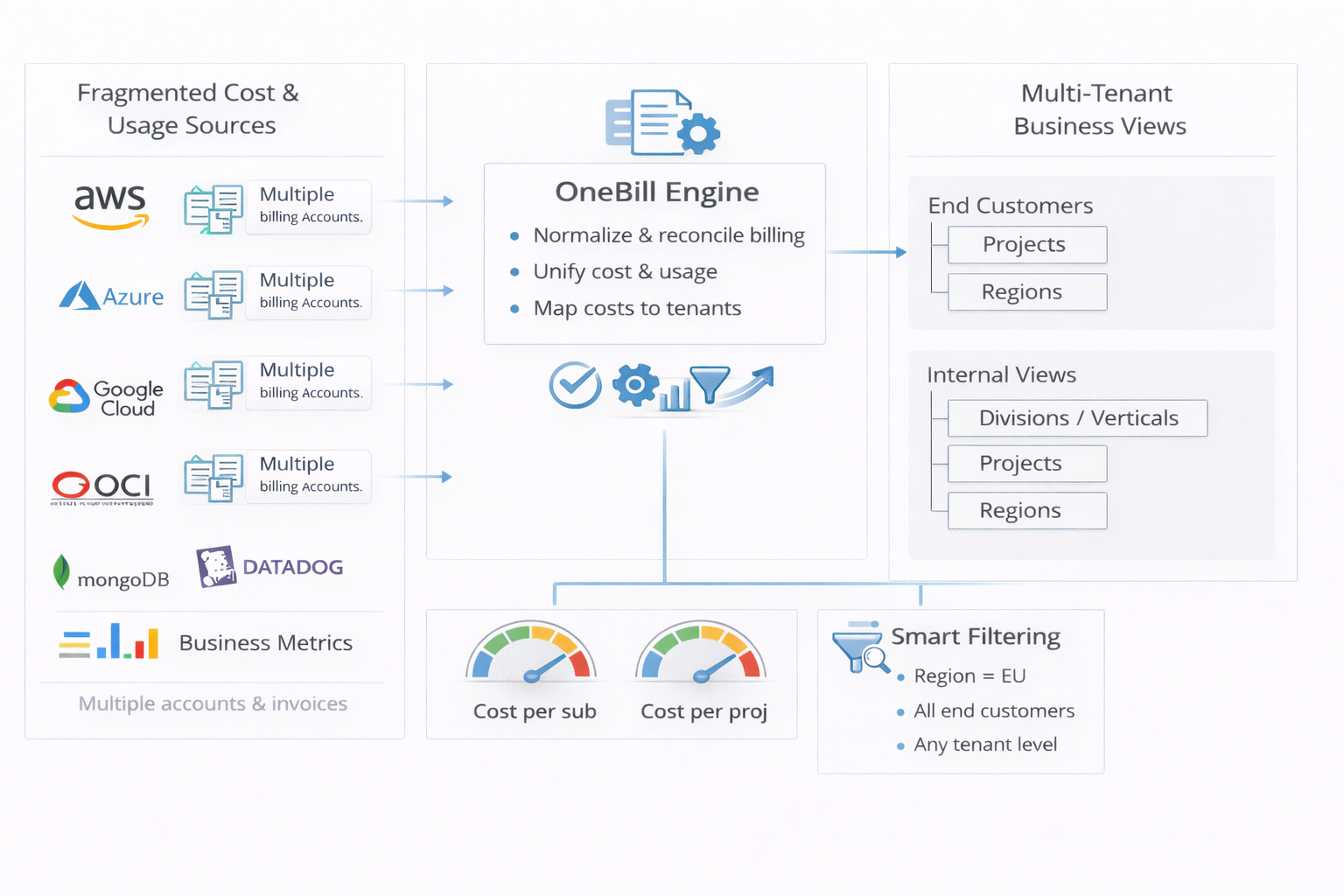
The real complexity starts at the source. A single enterprise or service provider isn't pulling from one billing feed. They're ingesting data from:
- Multiple billing accounts per vendor. Some created deliberately, some inherited from acquisitions, some left over from abandoned projects. Each vendor structures them differently too: AWS has organizations and accounts, Azure has management groups and subscriptions, GCP has folders and projects.
- Multiple vendors simultaneously. AWS, Azure, GCP, and others — each with different billing structures, different naming conventions, and different levels of granularity.
- Kubernetes workloads layered on top. K8s clusters cut across accounts and cloud providers, making namespace-level cost attribution even harder to untangle.
- Commitment instruments scattered across all of it. Reserved Instances, Savings Plans, and committed use discounts that were purchased at different account levels and need to be allocated fairly across tenants.
Before you can show any tenant — internal team or external customer — what they owe or consume, you have to normalize and reconcile all of that into a single coherent picture. That's where most tools fall short. It's also exactly where CloudHiro starts.
Cloud environments were never single-tenant. But most billing and FinOps tools still are. CloudHiro's multi-tenant, multi-cloud billing capability is built to close that gap — for enterprises managing internal cost owners and for service providers managing cloud spend on behalf of customers.
Stop Guessing. Start Seeing Across Every Cloud, Every Team, Every Tenant
That's where the OneBill Engine comes in. Rather than asking you to clean up your account sprawl or consolidate vendors first, it meets you where you are. It ingests all the scattered billing data across every vendor, every account, every engagement model — and normalizes it into a single coherent repository. As it does, it tags each line of consumption with a rich profile: who generated it, where it came from, what commitment it's drawing from. That tagging is what makes the magic possible on the other side. When it's time to break everything back down cleanly by team, customer, project, or any tenant structure that makes sense for your business, the data is already ready.
At its core, CloudHiro gives you:
- Full aggregation of all cloud billing data down to Kubernetes namespace and workload granularity
- Dynamic consolidation and re-allocation by tenant, in real time
- Live visibility into usage, cost, and commitment consumption — not last month's invoice
For Service Providers: Deliver Transparency That Wins Customers
For service providers, multi-tenant billing isn't just an operational tool — it's a competitive advantage. CloudHiro gives service providers and resellers a customer-facing billing and protection layer that goes well beyond passing through cloud costs.
Transparency that builds lasting trust
Today, most end customers are flying blind. They receive an invoice at month-end with little visibility into what drove it. They have no way to see their actual spend as it happens, no clarity on how discounts and negotiated rates are being applied, and no insight into how much of their shared commitments have already been consumed.
CloudHiro changes that. Customers get live visibility into their actual cloud spend — including applied discounts, real-time cost trends, and exactly how much of their committed use they have consumed at any point in the day. No more surprises at month-end.
Margin protection before problems become expensive
CloudHiro continuously monitors consumption patterns, detects abnormal usage behavior, and alerts on potential cost overruns before invoices are finalized. Both the service provider and end customer are protected.
A platform for new revenue streams
Multi-tenant billing creates a foundation to confidently offer:
- Managed optimization and FinOps services
- Commitment and Savings Plan management
- Resale of additional cloud and platform services
For Enterprises: Turn Cloud Spend Into a Conversation, Not a Debate
Inside large organizations, cloud spend rarely aligns neatly with org charts. Business units, product groups, R&D teams, shared platforms — they all consume cloud resources, but ownership is murky and invoices arrive too late to act on.
CloudHiro lets enterprises define logical tenants that reflect how the business actually operates:
- Business units and product groups
- IT vs R&D
- Projects or initiatives
- Any custom vertical that makes sense for your organization
Each team gets real-time visibility into their own usage across all cloud providers — with accurate showback or chargeback, clear ownership of shared services, and transparent insight into how shared commitments like Reserved Instances and Savings Plans are consumed.
Instead of debating spreadsheets after the fact, teams can see exactly what they're consuming right now. That shifts FinOps from retrospective reporting to operational decision-making.
From Billing Visibility to Business Leverage
Multi-tenant billing is more than a reporting feature. It creates accountability across teams and customers, transparency across shared environments, and protection against uncontrolled cost growth.
With CloudHiro, organizations and service providers gain real-time control over who is consuming what and how that translates into cost, commitments, and business outcomes.
Ready to See It in Action?
Whether you're managing internal cost centers or billing on behalf of dozens of customers, CloudHiro's multi-tenant billing capability gives you the clarity and control to act — not just report.
- →Book a demo to see live multi-tenant billing in your environment.
- →Explore the CloudHiro platform documentation.
- →Talk to a FinOps specialist about your use case.