
Azure’s End to Reservation Exchanges: A Disguised, Drastic Price Raise That Will Drive Repatriation
Ending exchanges forces Azure customers to choose between smaller discounts and rigid commitments—and changes the economics of long-term cloud planning.
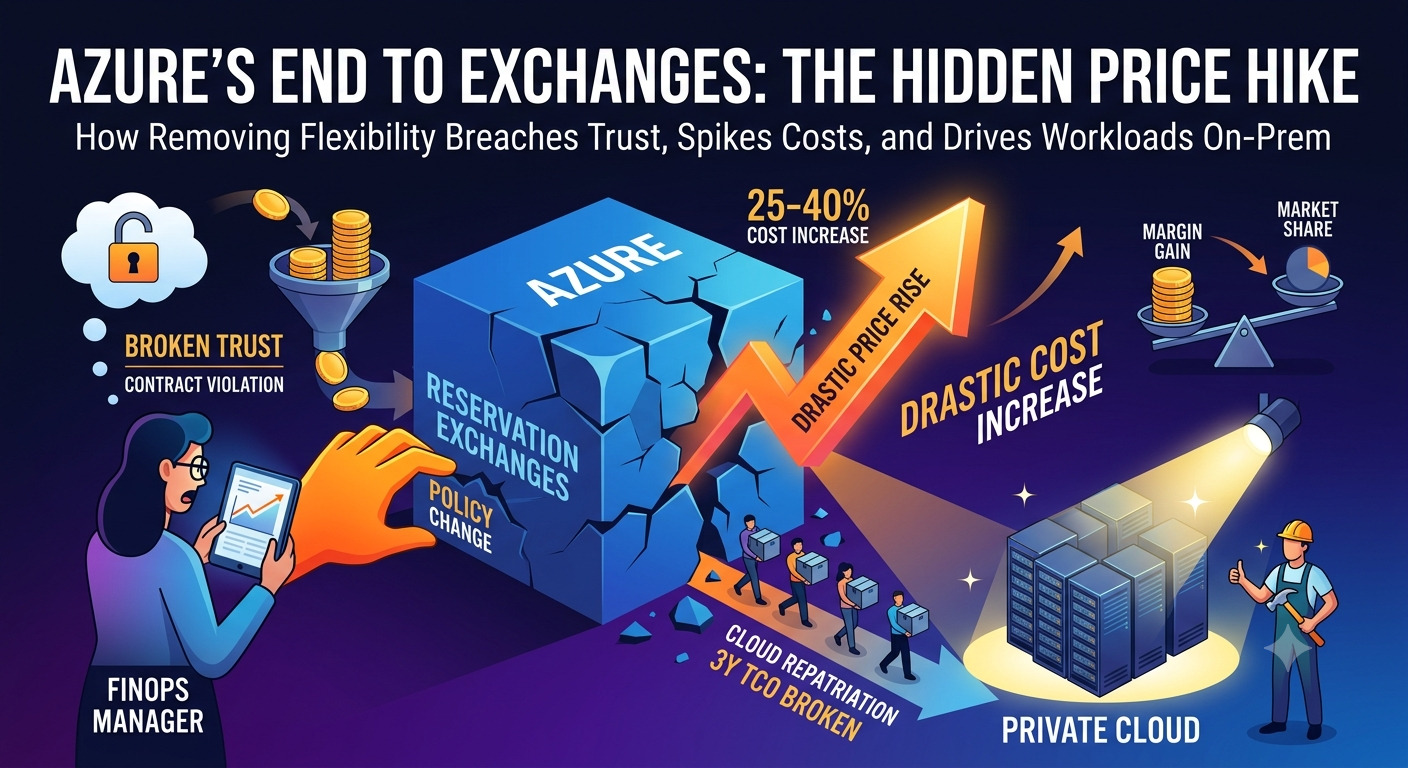
TL;DR
- In a side note in the Microsoft Tech Community announcement , Microsoft announced that, as of February 1, 2027, reservation exchanges will no longer be available for services covered by Azure Savings Plans.
- This is a huge price hike disguised as a policy change. It will cost customers 25–40% more on substantial parts of their cloud bills.
- This breaks trust with customers and may conflict with commitments made through their EA/MACC agreements and when they purchased Reserved Instances.
- The notice is far too short. I hope this is another attempt Microsoft will back down from, as it did the previous two times. Otherwise, this short-sighted strategy will drive repatriation.
- Azure database customers could face a shocking bill increase because some Savings Plans offer only one-year coverage while Reserved Instances offer three-year terms.
- To help, we created a free RI vs. Savings Plan analysis page . Upload your current RIs, assess the financial impact of moving them to Savings Plans, and discuss the result with your Microsoft Azure representative.
The details
Microsoft Azure recently dropped a significant policy announcement : starting February 1, 2027, reservation exchanges will no longer be available for services covered by Azure Savings Plans. This applies to critical infrastructure services including Virtual Machines, App Services, Dedicated Hosts, and core database offerings such as SQL Database, PostgreSQL, MySQL, and Cosmos DB.
While marketed under the banner of streamlining discount frameworks and aligning policies, let’s call this what it actually is: a massive, retroactive price hike on enterprise cloud infrastructure.
Here is why this decision breaks trust, shatters traditional cloud TCO calculations, and will ultimately drive workloads back on-premises.
1. Why Ending Exchanges Is an Effective Price Increase
To understand why this is a drastic cost increase, consider the financial trade-offs between Reserved Instances and Azure Savings Plans:
- Reserved Instances (RIs) offer the deepest discount tier—frequently 60–72% off pay-as-you-go rates—because you commit to a specific instance family and region. Exchanges, however, make the commitment flexible across families and regions and can also change the daily spend.
- Savings Plans offer maximum flexibility across regions and compute types, but with significantly smaller discount rates—often 25–30% lower savings than three-year RIs—and no flexibility on daily spend for the duration of the plan.
Until now, reservation exchanges allowed FinOps teams to lock in the highest discount available while maintaining a safety net. If an engineering team upgraded from an older VM generation, such as Dv3, to a newer, cheaper, or faster series, such as Dv5—or migrated workloads to another region—it could exchange the existing reservation without losing the financial commitment and discounts.
By removing exchanges, Microsoft creates a lose-lose dilemma:
Option A: Lower savings
Choose Azure Savings Plans to retain flexibility, resulting in an immediate 25–40% effective price increase due to smaller discounts and lower overall coverage.
Option B: Unusable shelfware
Keep RIs for the maximum discount but accept total rigidity. When the architecture, region, or instance type changes, an unused reservation becomes wasted cash.
Either way, total cloud expenditure increases significantly.
2. Breaking the Customer Contract
When enterprise buyers purchase one-year or three-year reservation commitments, they do so based on the features and rules defined at purchase. Exchange flexibility was not a minor line item; it was a core value proposition used by Microsoft sales teams to close multi-million-dollar commitments.
Even with a transition period—giving existing reservations one final exchange after February 2027—shifting the underlying mechanics midstream breaks the operational trust between Azure and its enterprise customers.
Customers entered multi-year Enterprise Agreements based on a dynamic risk-management framework. Stripping away exchangeability retroactively transfers the technical and financial risk back to customers while Microsoft secures locked-in revenue.
3. Unrealistic Timelines and Fiscal Shock
Short Timeframe to Act
Notice periods under six months are nowhere near sufficient for complex organizations. Mid-market companies and Fortune 500 enterprises operate on lengthy, multi-quarter planning cycles. Refactoring architecture, auditing thousands of active reservations, renegotiating cloud allocations, and securing board approval for budget changes all take time. Forcing enterprises to react within such a tight window makes structured planning virtually impossible.
Direct Budget Inflation
For organizations that rely heavily on RIs to keep infrastructure spending manageable, a forced migration to Savings Plans will wreak havoc on budgets. Because Savings Plan discount rates are substantially lower, shifting spend can increase unit costs by more than 30% compared with three-year RIs for equivalent workloads. Unplanned budget spikes of this magnitude force leadership to pull funding from active product development just to keep the lights on.
The Database “Term Trap”
The financial shock is particularly severe for database workloads. While many compute SKUs support three-year terms under both models, Azure Savings Plans for Databases are capped at one year, whereas Reserved Instances for databases—especially SQL Managed Instances—have historically offered deep three-year discounts.
By eliminating exchanges on database RIs, Microsoft effectively pushes database users toward one-year Savings Plans. The loss of multi-year term discounting, combined with lower base savings rates, creates a dramatic price cliff that could cause database infrastructure costs to rise sharply.
4. The Math Is Broken: Accelerating Cloud Repatriation
For years, hyperscalers argued that public cloud infrastructure offers a lower Total Cost of Ownership than on-premises data centers—or at least similar costs with significantly better scalability, flexibility, redundancy, and time to market. That calculation depended heavily on aggressive FinOps optimization: using reservation exchanges to keep utilization and coverage high and unit costs low as workloads evolved.
Take away exchange flexibility, and the cloud TCO model collapses.
Cloud complexity is already reshaping hardware demand. A friend who works for a major enterprise hardware vendor recently boasted that he is “making a great living specifically helping enterprise clients pull workloads out of the cloud and back on-premises.”
Cloud repatriation is no longer hypothetical; it is a growing business driven by enterprises tired of unpredictable bills and policy shifts. When modern servers offer predictable three-year depreciation cycles, high density, and fixed power costs, an unexchangeable cloud reservation suddenly looks like an expensive trap.
5. Margin Gain Today, Market Share Loss Tomorrow
Microsoft’s motivation appears transparent: higher commitment lock-in and lower discount depth directly boost Azure’s cloud gross margins in the short term. Wall Street rewards margin expansion, and removing exchange liabilities improves financial predictability.
However, this is a short-sighted strategy.
In enterprise software, trust and predictability are king. When cloud providers erode discount flexibility and squeeze margins from locked-in clients, customers adapt. They diversify across multi-cloud setups, invest heavily in cloud-agnostic architecture—such as Kubernetes and open-source databases—or build modern on-premises infrastructure where costs can actually be fixed.
What Microsoft gains in short-term operating margin, it may lose in long-term enterprise market share. FinOps teams will remember who changed the rules when it is time to renew their Enterprise Agreements.
6. How Can We Help?
We built a page where you can upload your current RIs and receive an analysis of the financial impact of moving them to Savings Plans. Take that number to your Microsoft Azure account manager and start a discussion about how this change affects your organization.
Check your RIs vs. Savings Plans